




Case studies show how our products perform in different industries and different material clogging problems. This time, it is about solving the bridging problem with titanium dioxide, which is used by a major international paint and coating manufacturer.
[problem]
In order to produce better quality products, a major international paint and coatings manufacturer had to use a new grade of titanium dioxide (TiO2) . During material testing, the new grade of TiO2 encountered flow problems that the existing grade did not. The new material consisted of finer, lighter particles and tended to bridge over the vibratory feeder system that was installed in the storage silo.
[solution]
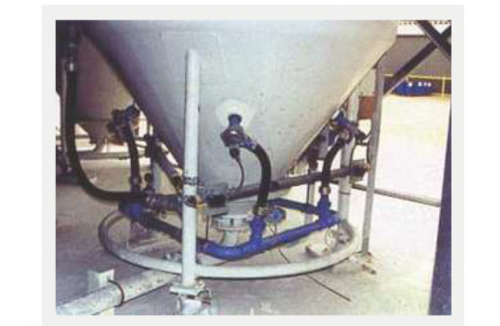
To solve this problem, the coating manufacturer replaced the feeder with a live bin bottom (multi-screw feeder) and installed four VA-12 (medium 40A) air sweep units about 60 cm above the live bottom. I installed it.
When the flow detector detected the upper bridge of the live bottom, an air sweep was automatically activated, resulting in a steady material flow. As a result, the TiO2 flow from the live bottom system now feeds beyond the capacity of the system's screw conveyor. The collection hopper was used as a buffer hopper to feed the screw, but the material was also bridging above the buffer hopper exit, which was about 25 cm in diameter. Installing four additional VA-12 air sweeps in the buffer hopper completely solved the bridging problem and ensured a constant feed rate to the screw.
Newer grades of TiO2 were also causing flow problems in pneumatic conveying vessels. The material proved difficult to aerate and the container was not completely empty during the batch cycle.
Two or three transport cycles had to be activated to completely empty the container, taking up to 50 minutes to transport the entire batch approximately 100m. After installing four "medium air sweeps" VA-12, the pneumatic conveying vessel was completely emptied in one cycle, reducing the batch time to 15 minutes.
[results]
By solving a process problem using an air sweep system, a coating manufacturer was able to achieve higher-than-expected production capacity while producing high-quality products.