




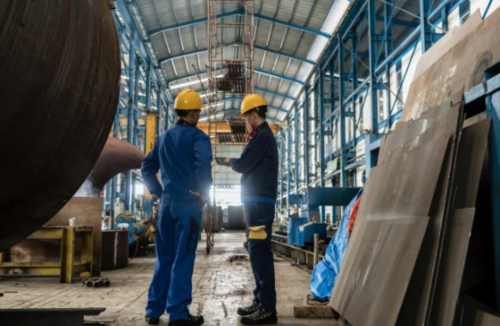
There is a high possibility that a serious accident will occur due to carelessness at a machine work site, and it is important to take measures to prevent it from occurring. Lock-out tag-out (LOTO) is an effective way to ensure machine safety. However, there is a concern that costs will increase if these are placed in various places in the workplace. Although the safety of workers is the number one priority, the real intention of the site is to realize cost reduction at the same time.
"Single point lockout" is useful as a means to achieve both safety and cost reduction. What kind of concept is single point lockout and what kind of accidents can be prevented?
Lockout/tagout to prevent human error
First, I would like to introduce the role and importance of lockout and tagout.
When approaching a machine for maintenance, etc. at a machine work site, it is necessary to stop the operation of the machine. After that, lockout and tagout are safety measures taken to prevent inadvertent reactivation.
Lockout (LO) refers to locking the machine after surely stopping its operation. The reason why it is necessary to lock the system is that if the system is simply stopped, a third party who is unaware of the situation may perform careless operations. Furthermore, the lock must not be something that anyone can remove, and it is desirable to have a physical lock such as a padlock instead of an electronic lock. Tag-out (TO) is to set up a tag with the content "Locked out due to work in progress" on top of it to make it easy to understand visually.
If lockout and tagout are not thoroughly implemented, workers may be in danger, and in some cases, it may lead to serious accidents. It is important that lockouts and tagouts are implemented in all relevant parts of the machine when workers approach the machine to do some work.
Single point lockout for added efficiency and safety
If a lockout/tagout mechanism is introduced without omission and all workers are made aware of the points to be careful of, safety is ensured in terms of the mechanism. However, relying on human attention may cause workers to skip tasks on their own in an attempt to shorten the time. In addition, if all points are locked out and tagged out, there is a concern that the time the machine will be stopped will be extended and the operating time will be reduced. A single point lockout solves these challenges simultaneously.
A single point lockout is a combination of lockout points that tend to span multiple locations, and is intended to stop all machines with a single lockout/tagout. With this method, lockout/tagout can be completed with the minimum amount of time and effort, so skipping by workers can be prevented.
Single point lockout is also a useful mechanism for efficient use of time. If it's something that requires a certain amount of time, such as regular maintenance, it's fine, but if there's a little clogging on the production line, the length of the downtime will lead to a significant drop in efficiency. This is because it takes more time to lock out/tag out multiple points and release them than to deal with short stoppages. A single point lockout eliminates the need to go back and forth between multiple points, greatly reducing downtime caused by short stops.
In this way, single-point lockout can achieve both safety and efficiency, but in principle, the basics of lockout and tagout are observed in operation. If you introduce it on top of that, it will lead to cost reduction while preventing serious accidents due to carelessness of workers. Consider installing a single point lockout to bring safety and efficiency to your machine work.