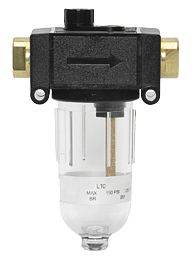




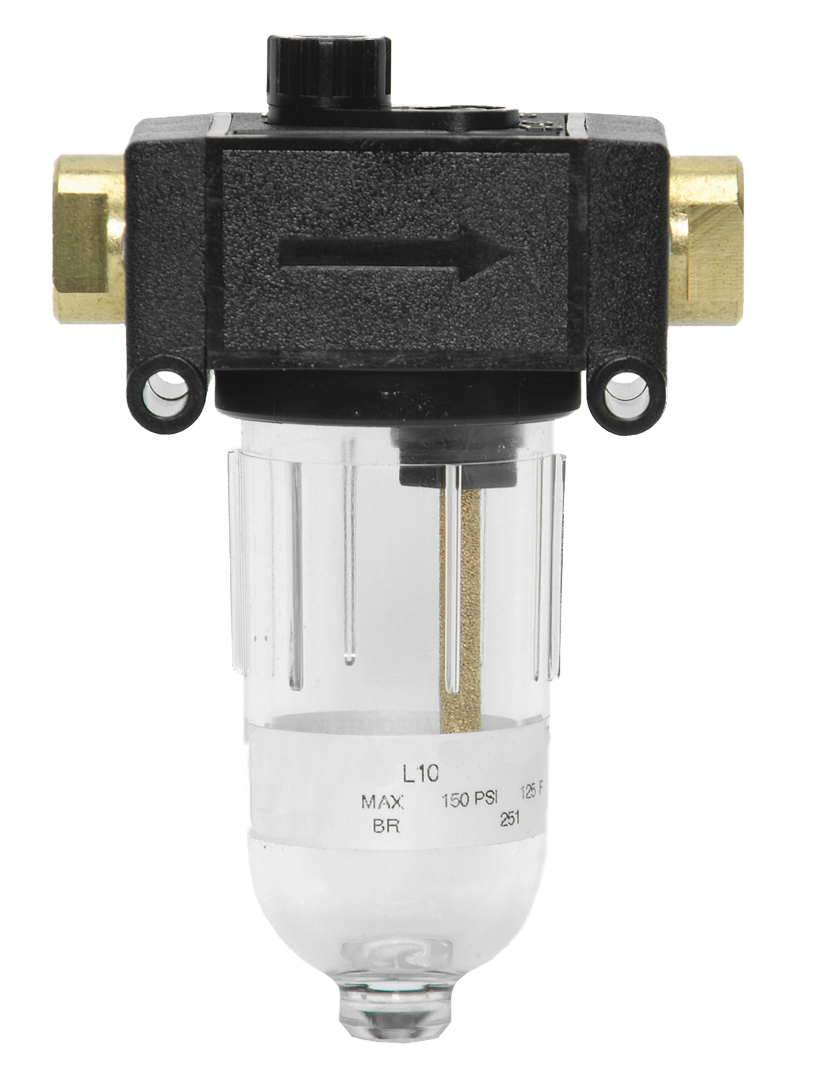
Bantam Series Port Sizes 1/8" & 1/4"; Flow to 27 scfm (765 l/min)
 Data Sheet
- Modular assembly and mounting
- Threaded ports or quick-connect fittings for tubing up to 10 mm in diameter
- Wick-feed design
loading...
loading...
Product Overview
The ROSS Controls Bantam Series is a family of compact, modular wick-feed lubricators designed for pneumatic systems requiring precise, consistent oil delivery in small port size applications. With port sizes of 1/8 and 1/4 inch (NPTF or G/BSPP threads) and quick-connect tube fittings from 1/4 inch to 10 mm, the Bantam Series accommodates a wide range of plumbing configurations in a minimal footprint.
Each Bantam lubricator uses a wick-feed mechanism to deliver oil into the compressed air stream at a controlled, repeatable rate. The wick orientation and depth within the body determines oil output, giving maintenance personnel a straightforward mechanical means to adjust lubrication levels without external tooling. Oil adjustment is external with no shutoff, allowing field changes without system depressurization.
The Bantam Series is constructed with acetal polymer bodies and is available with either 2-oz (60-ml) polycarbonate plastic bowls rated to 150 psig (10 bar) or aluminum metal bowls rated to 200 psig (14 bar). Nitrile seals provide compatibility with standard petroleum-based lubricating oils and maintain sealing integrity across the rated temperature range.
Modular assembly capability allows Bantam lubricators to be joined directly with ROSS Bantam Series filters and regulators without pipe nipples; ports are O-ring sealed between units. This enables a complete, compact FRL station for light-duty pneumatic equipment, instrumentation, and small pneumatic actuator circuits.
Key Engineering Features
- Wick-Feed Lubrication Design - Delivers a continuous, controlled flow of oil into the compressed air stream. Wick position (up, down 1 groove, or down 2 grooves) adjusts oil delivery rate to match application requirements.
- Modular Assembly and Mounting - Joins directly to ROSS Bantam Series filters and regulators without pipe nipples. O-ring sealed modular ports eliminate threaded connections between units, reducing leak points.
- Threaded Ports and Tube Fitting Options - Available with 1/8 and 1/4 inch NPTF or G (BSPP) threaded ports, or quick-connect tube fittings for 1/4 inch, 3/8 inch, 4 mm, 6 mm, 8 mm, and 10 mm OD tubing.
- External Adjustment, No Shutoff - Oil delivery rate is adjusted externally without interrupting air flow or depressurizing the system, simplifying maintenance during continuous production.
- Quick-Fill Cap Option - Available on all Bantam models. Quick-fill cap allows oil reservoir refilling under pressure without removing the bowl, minimizing downtime during preventive maintenance.
- Polycarbonate or Aluminum Bowl - 2-oz (60-ml) polycarbonate bowl for standard applications up to 150 psig (10 bar) and 125°F (52°C). Aluminum metal bowl extends pressure rating to 200 psig (14 bar) and temperature to 150°F (66°C).
- Compact, Lightweight Construction - Acetal body with a total weight starting at 0.17 lb (0.08 kg) for the no-port blank configuration, and 0.37 lb (0.17 kg) for ported variants. Minimizes load on pneumatic manifolds and wall mounts.
- Nitrile Seals for Petroleum Oil Compatibility - Standard nitrile (Buna-N) seals maintain elasticity and sealing performance with petroleum-based lubricants across the full rated temperature range.
Technical Specifications
General Specifications
| Parameter | Specification |
| Series | Bantam |
| Lubrication Type | Wick-Feed |
| Port Sizes (Threaded) | 1/8 and 1/4 inch NPTF; 1/8 and 1/4 inch G (BSPP) |
| Port Sizes (Tube Fittings) | 1/4 inch, 3/8 inch, 4 mm, 6 mm, 8 mm, 10 mm OD |
| Maximum Flow | 27 scfm (765 l/min) |
| Minimum Flow | 1 scfm (0.47 l/s) at 100 psig (6.9 bar) inlet |
| Operating Pressure (Polycarbonate Bowl) | Maximum 150 psig (10 bar) |
| Operating Pressure (Metal Bowl) | Maximum 200 psig (14 bar) |
| Fluid Media | Compressed air |
| Ambient/Media Temperature (Polycarbonate Bowl) | 40 to 125 F (4 to 52 C) |
| Ambient/Media Temperature (Metal Bowl) | 40 to 150 F (4 to 66 C) |
| Bowl Capacity | 2 oz (60 ml) |
| Mounting | Modular assembly and mounting |
| Body Material | Acetal |
| Bowl Material | Polycarbonate or Aluminum |
| Seal Material | Nitrile |
| Oil Adjustment | External; no shutoff |
| Fill Method | Fill port (standard) or Quick-fill cap (optional) |
Certifications & Compliance
Typical Applications & Industries
Pneumatic Instrumentation and Control Panels
- Instrument air systems for valve positioners, I/P transducers, and pneumatic controllers where small, precise lubrication of seals and actuator components is required without excess oil carryover.
- Miniature pneumatic cylinder circuits in assembly automation where tight installation space restricts use of larger lubricator bodies. The Bantam's modular footprint fits directly into quarter-inch tubing manifolds.
- Analytical and laboratory equipment using small pneumatic actuators, where consistent lubricant delivery at flow rates as low as 1 scfm prevents actuator seal wear without contaminating sensitive downstream components.
Food and Beverage Equipment (Non-Direct Contact Zones)
- Packaging machine actuators and pneumatic escapements in secondary packaging operations where small-bore air lines require lubrication. Polycarbonate bowl allows visual confirmation of oil level during sanitation checks.
- Conveyor diverter actuators and pneumatic stops on food-grade packaging lines in non-contact product zones, where a compact lubricator is needed to maintain actuator performance between scheduled maintenance intervals.
- Small solenoid valve actuators on labeling and date-code printing equipment, where consistent lubricant delivery prolongs solenoid stem life in high-cycle applications.
Textile and Printing Machinery
- Textile machine pneumatic needle and shuttle actuators operating at 1/8 and 1/4 inch air lines, where the Bantam's wick-feed design ensures uninterrupted lubrication during continuous production shifts.
- Screen printing and digital finishing equipment with multiple small pneumatic circuits, where modular assembly reduces plumbing complexity by joining filter, regulator, and lubricator in a single inline assembly.
- Yarn tension and bobbin winding controls using micro-pneumatic actuators, where precise low-flow lubrication at under 5 scfm is required to prevent over-lubrication and downstream oil contamination.
Electronics and Semiconductor Manufacturing
- Pick-and-place pneumatic grippers in PCB assembly equipment, where polycarbonate bowls allow oil level monitoring without stopping production and tube-fitting ports match standard 6 mm and 8 mm automation tubing.
- Component handling pneumatic slides and rotary actuators in semiconductor packaging, where low-flow wick lubrication maintains seal integrity in high-cycle applications while minimizing oil vapor introduction into cleanroom-adjacent zones.
- Test fixture pneumatic clamps and probers in functional test systems, where the Bantam's modular mount integrates directly with co-located filter and regulator units without additional plumbing hardware.
HVAC and Building Automation
- Pneumatic damper actuators in commercial building HVAC systems where 1/4 inch air lines serve zone dampers. Modular Bantam units install directly in the control air header without separate fittings.
- Building automation pneumatic valve actuators for chilled water and hot water control valves, where consistent lubrication reduces actuator stem wear and extends mean time between maintenance actions.
- Compressed air-driven pressure switches and relay panels in process buildings, where small lubricators maintain moving components in pneumatic logic circuits over multi-year service intervals.
Automotive and General Assembly
- Small pneumatic nut runners and air screwdrivers on automotive assembly lines, where 1/4 inch air supply circuits require controlled lubrication to maintain tool vane and bearing performance at high duty cycles.
- Robotic end effector pneumatic circuits with quarter-inch supply lines, where the Bantam Series fits in restricted spaces while providing reliable wick-feed lubrication to gripper and compliance mechanism seals.
- Pneumatic torque multipliers and impact tools in final assembly operations, where tool air lines rated below 150 psig benefit from polycarbonate bowl models and external oil adjustment accessible during production.
Ordering and Model Number Configuration
The ROSS Bantam Series uses a structured model number system. Prefix C denotes G (BSPP) threads. The ninth digit can be changed to 7 for a quick-fill cap variant.
|
Model Number Structure: 5 B 0 1 B 0 0 0 5
5 Product Family (5 = Lubricator)
B Size Code (B = Bantam)
0 1 Port Size Code (01 = 1/8 NPT; 02 = 1/4 NPT; 03 = 1/4 tube; 04 = 3/8 tube; 05 = 4mm; 06 = 6mm; 07 = 8mm; 08 = 10mm)
B Series Level
0 0 Configuration Code
0 5 Fill/Bowl Code (05 = Polycarbonate Fill Port; 06 = Metal Fill Port; 07 = Polycarbonate Quick-Fill; 08 = Metal Quick-Fill)
Prefix C = G (BSPP) threads |
NPT models have no prefix. G (BSPP) thread models are prefixed with C (e.g., C5B01B0005).
Change the ninth digit to 7 for a quick-fill lubricator cap on standard models (e.g., 5B01B0007).
Wick orientation codes for oil delivery rate: HA = Wick Up (highest delivery), HB = Wick Down 1 Groove, HC = Wick Down 2 Grooves; L-series for low oil delivery variants.
Accessories
Modular Blank Spacer
A no-port blank unit (model 5B00B0005 and variants) can be installed as a modular spacer in the Bantam Series assembly, allowing future lubricator addition or serving as an end cap in filter-regulator-only configurations.
ROSS Bantam Series Filters
5-micron rated polyethylene filter elements in Bantam Series filter bodies mount directly to Bantam lubricators. Available with automatic internal drain or manual drain. Polycarbonate or aluminum bowl options.
ROSS Bantam Series Regulators
Piston-type and diaphragm-type Bantam regulators mount in-line with Bantam filters and lubricators. Adjustment range 0 to 100 psig (0 to 7 bar) with locking key for tamper-resistant pressure setting.
Related Products & Accessories
- 105 Miniature Series Lubricators - Inline wick-feed lubricators for 1/8 and 1/4 inch ports with internal tamper-proof adjustment. Flow to 25 scfm. High-flow and low-flow models. https://www.rosscontrols.com/en/series/105-miniature-series
- 106 Mid-Size Series Lubricators - Modular sight-feed lubricators for 1/4 to 1/2 inch ports. Flow to 110 scfm. Polycarbonate or zinc bowl with zinc shatterguard. https://www.rosscontrols.com/en/series/106-mid-size-series
- MD3 Series Lubricators - Modular sight-feed lubricators for 1/4 to 1/2 inch ports. Flow to 150 scfm. Transparent dome oil monitoring with removable external adjustment knob. https://www.rosscontrols.com/en/series/107-md3-series
- 108 Full-Size Series Lubricators - Modular or inline sight-feed and wick-feed lubricators for 1/4 to 3/4 inch ports. Flow to 140 scfm. 8-oz bowl capacity. https://www.rosscontrols.com/en/series/108-full-size-series
- Bantam Series FRL Combinations - Complete modular filter-regulator-lubricator combination units in Bantam Series, providing all three functions in a single compact assembly. https://www.rosscontrols.com/en/series/139-bantam-series
Frequently Asked Questions (FAQ)
Q: What is the difference between the Bantam Series lubricator and the Miniature Series?
A: The Bantam Series is designed for modular assembly, joining directly to other Bantam components without pipe nipples. It features an external adjustment with no shutoff and uses an acetal body. The Miniature Series (105) is designed for inline mounting with an internal tamper-proof adjustment and uses an aluminum body. Both cover 1/8 and 1/4 inch port sizes, but the Bantam adds tube fitting options from 1/4 inch to 10 mm OD.
Q: What oil viscosity is recommended for the Bantam Series lubricator?
A: Use petroleum-based oil with an aniline point between 180 F and 220 F, ISO 32 viscosity or lighter, at approximately one drop per minute for typical pneumatic tool applications. Avoid phosphate-ester type additives, which are incompatible with nitrile seals.
Q: Can I refill the oil reservoir without removing the bowl?
A: Yes, when ordering with the Quick-Fill Cap option (ninth digit = 7 in the model number, e.g., 5B01B0007). The quick-fill cap allows pressurized oil addition without depressurizing or removing the bowl. Standard fill port models require system depressurization before removing the bowl to add oil.
Q: How do I adjust the oil delivery rate?
A: The Bantam Series uses wick position to set oil delivery. Three wick positions are available: Wick Up (HA - highest delivery), Wick Down 1 Groove (HB - medium delivery), and Wick Down 2 Grooves (HC - low delivery). Low-delivery versions (L-codes) provide even finer control for very low-flow applications under 5 scfm.
Q: What is the maximum inlet pressure for the Bantam lubricator?
A: The polycarbonate bowl version is rated to a maximum of 150 psig (10 bar). The aluminum metal bowl version is rated to a maximum of 200 psig (14 bar). These ratings apply to the lubricator body only; verify that any connected filter or regulator in the FRL assembly is also rated for the same or higher pressure.
Q: Are G (BSPP) thread models available?
A: Yes. G thread (BSPP, metric/European) models are available for all Bantam Series lubricators. Add a C prefix to the model number (e.g., C5B01B0005 for 1/8 G thread with polycarbonate bowl). Tube fitting models are dimensionally equivalent between NPT and G configurations.
Q: Can the Bantam lubricator be used with tube fittings for metric tubing?
A: Yes. Tube fitting variants are available for 4 mm, 6 mm, 8 mm, and 10 mm OD tubing (models 5B05B through 5B08B), in addition to 1/4 inch and 3/8 inch OD inch tubing. These push-in style fittings integrate directly into the lubricator body.
Q: What is the minimum flow required to activate lubrication?
A: The minimum flow for the Bantam Series is 1 scfm (0.47 l/s) at 100 psig (6.9 bar) inlet pressure. Below this threshold, the wick-feed mechanism may not draw sufficient oil into the airstream to provide lubrication.
Q: Is the Bantam lubricator suitable for use with polycarbonate bowls near chemicals or solvents?
A: No. Polycarbonate bowls are not suitable for use in environments with chemical vapors, strong cleaning agents, paints, or organic solvents. In such environments, specify the aluminum metal bowl option. All ROSS FRL polycarbonate bowls are designed for compressed air service only.
Q: How is the Bantam Series installed in a modular FRL assembly?
A: Bantam components mount side by side on a common module rail or inline arrangement. Ports between units are sealed with O-rings; no pipe nipples or fittings are required between filter, regulator, and lubricator stages. The assembly is secured with tie bolts and end caps. Consult the ROSS FRL installation instructions for the current assembly procedure.
Q: What thread standard is NPTF?
A: NPTF stands for National Pipe Taper Fuel, a thread standard that creates a metal-to-metal seal without requiring thread sealant tape in properly machined connections. It is dimensionally compatible with NPT (National Pipe Taper) threads and is the standard used for ROSS pneumatic components in North American markets.
Q: Are replacement wicks and cartridges available?
A: Yes. All working parts of the Bantam lubricator are contained in an easily replaceable cartridge. Replacement cartridges and wick assemblies are available through ROSS Controls and authorized distributors. Refer to the ROSS catalog or contact ROSS technical support at (800) 438-7677 for part numbers.
Installation & Maintenance Guidelines
- Mount the Bantam lubricator downstream of the filter and regulator in the FRL assembly so that clean, regulated air enters the lubricator. Reversed installation will contaminate the oil reservoir.
- Install with the bowl in the downward orientation to maintain proper wick contact with the oil reservoir. Horizontal or inverted installation is not supported for the Bantam Series.
- Before filling, verify that the system is depressurized when using standard fill port models. Do not remove the bowl under pressure.
- Use only petroleum-based lubricants with an aniline point between 180 F and 220 F and ISO 32 viscosity or lighter. Synthetic lubricants, phosphate-ester fluids, and non-petroleum oils will degrade nitrile seals.
- Set the wick position to match the required oil delivery rate for the application: Wick Up (HA) for maximum delivery, Wick Down 1 Groove (HB) for medium, and Wick Down 2 Grooves (HC) for minimum. Start with a lower setting and increase if actuator wear is observed.
- Do not use polycarbonate bowls in the presence of chemical solvents, paint fumes, or cleaning agents. Replace with aluminum bowl option in those environments.
- Verify that all upstream filtration is functioning correctly. Contaminated air shortens wick service life and can carry particulates into lubricated components.
- For modular assembly, confirm O-ring seals are seated properly in all port faces before tightening tie bolts. Inspect O-rings for nicks or debris before assembly.
- After initial installation, inspect the bowl oil level after one week of operation to verify oil consumption is within the expected range. Adjust wick position if over-lubrication (excess oil in exhaust) or under-lubrication (premature actuator wear) is observed.
Warranty & Global Support
ROSS Controls provides a one-year warranty on all products, covering defects in material and workmanship from date of purchase.
Global technical support is available through ROSS offices in the USA (headquarters in Ferndale, Michigan), Canada, Brazil, Germany, France, United Kingdom, India, China, and Japan.
Contact ROSS Controls USA at (800) 438-7677 or (248) 764-1800, or visit rosscontrols.com for product configuration, technical support, and distributor locator services.
Download Catalog: https://www.rosscontrols.com/en/documents/198/ROSS_FRL_Combination_Units_Filter_Regulator_Lubricator.pdf
Download Documents
Bantam Series