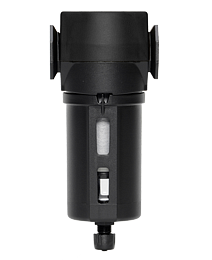




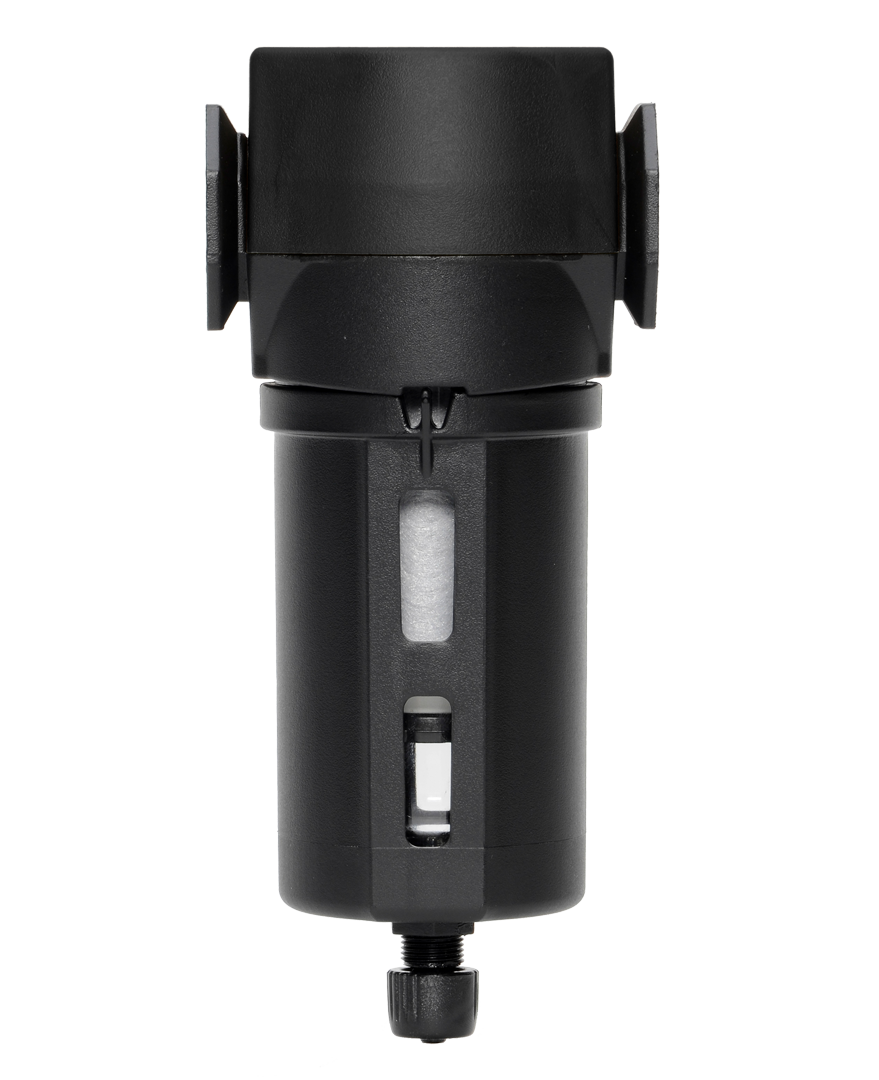
MD3 Series Port Sizes 1/4 to 1/2; Flow to 125 scfm (3540 l/min)
 Product Catalog
loading...
loading...
Product Overview
The ROSS Controls MD3 Series adsorbing filters are purpose-built oil vapor removal units designed to deliver the final stage of compressed air purification in applications where standard particulate and coalescing filtration is not sufficient. Using activated carbon elements, these filters remove oil and hydrocarbon vapors, odors, and contaminants from compressed air lines that coalescing filters cannot capture, producing air that is virtually free of oil and hydrocarbons as required by industries such as food processing, electronics, pharmaceuticals, and instrumentation.
The MD3 adsorbing filter is available with port sizes of 1/4, 3/8, and 1/2 inch in NPT or BSPP (G) thread configurations, with a maximum flow capacity of 125 scfm (3,540 l/min). Three bowl options are offered: polycarbonate, metal (aluminum), and extended metal bowl, with the extended option providing up to 50 percent greater air flow by accommodating a higher-capacity adsorbing cartridge. All MD3 adsorbing filter variants use aluminum bowls as a standard feature for the metal option and require manual drain operation.
As the third stage in ROSS Controls' Clean Air Package filtration sequence, the MD3 adsorbing filter must always be preceded by a standard particulate filter (5-micron) and a coalescing filter (0.3-micron or 0.01-micron). This three-stage assembly is the foundation of ROSS Controls' MD3 Clean Air Package, which delivers outlet air quality with no more than 0.01 mg/m3 of residual oil content, meeting the most stringent compressed air purity requirements.
The ROSS MD3 adsorbing filter series is modularly compatible with the complete ROSS MD3 FRL product family, including particulate filters, coalescing filters, and regulators. This modular architecture allows design engineers to configure compact, space-efficient air preparation stations from a single product family without external pipe fittings between stages.
Key Engineering Features
- Activated Carbon Adsorbing Element - Cartridge contains activated carbon to adsorb hydrocarbon vapors, oil mist aerosols, and odors from alcohols, esters, and ketones that pass through upstream coalescing filtration, delivering air virtually free of oil and hydrocarbons.
- Three Bowl Options - Polycarbonate (5.1 oz/151 ml), metal aluminum (6 oz/177 ml), and extended metal aluminum (10 oz/295 ml) bowls match different pressure, temperature, and flow capacity requirements.
- Extended Bowl for Higher Flow - Optional extended aluminum bowl accommodates a higher-capacity adsorbing cartridge, providing up to 50 percent greater air flow through the filter without increasing the port size.
- Port Sizes 1/4 to 1/2 - Available in 1/4, 3/8, and 1/2 inch port sizes in NPT (NPTF) or BSPP (G) threads, covering the most common compressed air system configurations in the MD3 flow range.
- Modular Assembly Compatible - Designed to connect directly to other ROSS MD3 FRL components in the same series without pipe fittings, enabling compact filter-coalescing-adsorbing-regulator assemblies in a single modular stack.
- High-Pressure Metal Bowl Option - Aluminum bowl option supports inlet pressures up to 250 psig (17 bar) with manual drain, extending applicability to high-pressure compressed air systems beyond the polycarbonate bowl's 150 psig limit.
- Configurable Cap Color - Bowl cap is available in gold, gray, yellow, red, and blue for visual identification of filter stage, media type, or maintenance schedule within multi-stage air preparation systems.
- Manual Drain Standard - Manual drain is standard on all adsorbing filter models. The adsorbing element does not generate significant liquid condensate, making automatic drain unnecessary for this filter stage.
- Replacement Filter Elements Available - Field-replaceable activated carbon cartridges (R-A60F-29E9 for standard bowls, R-A60F-32E9 for extended bowls) enable element replacement without replacing the filter body.
Technical Specifications
General Specifications
| Parameter | Specification |
| Series | MD3 Series Adsorbing (Oil Vapor Removal) Filters |
| Filter Stage | Third-stage adsorbing (must be preceded by particulate and coalescing filters) |
| Filtration Mechanism | Activated carbon adsorption; removes hydrocarbon vapors and odors |
| Port Sizes | 1/4", 3/8", 1/2" |
| Thread Types | NPT (NPTF); BSPP (G) |
| Maximum Flow | 125 scfm (3,540 l/min) standard bowl; up to 50% greater with extended bowl |
| Mounting | Modular |
| Drain Type | Manual drain (standard) |
| Body Material | Die-cast zinc |
| Bowl Options | Polycarbonate with nylon shatterguard; Aluminum with clear nylon sight glass; Extended aluminum with clear nylon sight glass |
| Seal Material | Nitrile |
| Element Material | Activated carbon with urethane seals |
| Fluid Media | Compressed air |
| Residual Oil Content | Less than or equal to 0.01 mg/m3 (when used as part of MD3 Clean Air Package) |
Certifications & Compliance
Typical Applications & Industries
Food and Beverage Processing
- Direct contact compressed air in food packaging, bottling, and ingredient dispensing systems where any trace of oil or hydrocarbon vapor would contaminate the product and violate food safety regulations. The MD3 adsorbing filter reduces residual oil to below 0.01 mg/m3, meeting food-grade air quality requirements.
- Pneumatic conveyors and product-contact air jets in bakery, confectionery, meat, and dairy processing lines where activated carbon adsorption eliminates the odors and taste-altering hydrocarbons that coalescing filters cannot capture.
- Blow-molding, labeling, and filling operations in beverage production where product contact air must be free of lubricant carryover from compressor systems.
Pharmaceutical and Life Sciences Manufacturing
- Instrument air and process air in pharmaceutical tablet coating, powder blending, and clean room automation where FDA-mandated air quality standards prohibit detectable oil contamination. The MD3 adsorbing filter provides the final hydrocarbon removal stage required for ISO 8573-1 Class 1 oil purity.
- Sterile filling lines, lyophilization systems, and biological processing equipment where compressed air contacts drug product packaging, container closures, or active pharmaceutical ingredients.
- Laboratory gas panels and analytical instrument supply lines where hydrocarbon contamination from compressor oil would interfere with measurement accuracy or corrupt reagent chemistry.
Electronics and Semiconductor Manufacturing
- Wafer handling, printed circuit board assembly, and component placement automation where hydrocarbon vapors from compressed air systems would deposit on semiconductor surfaces, causing failures in fine-pitch soldering, wire bonding, and photolithography processes.
- Clean room pneumatic actuation systems where air quality classifications (ISO 14644) require zero detectable hydrocarbon contamination from pneumatic components.
- Test and inspection equipment for electronics where oil vapor in instrument air would coat optical lenses, contaminate reference surfaces, and produce measurement drift.
Instrumentation and Process Control
- Instrument air supply for positioners, I/P transducers, and pneumatic process controllers where hydrocarbon contamination would foul instrument diaphragms, corrode orifice plates, and cause signal drift in sensitive control loops.
- Paint spray systems, precision coating booths, and adhesive application equipment where oil contamination in the air stream causes adhesion failures, surface defects, and product rejects.
- Breathing air supply stations in industrial environments where workers use compressed air for respiratory protection, requiring hydrocarbon vapor removal to meet OSHA and NIOSH air quality standards.
Automotive and Precision Manufacturing
- Painting booths and finishing lines in automotive manufacturing where compressed air for atomization must be free of oil contaminants that would cause fish-eye defects, adhesion failures, and coating delamination.
- Precision machining and metrology applications where air gauging and air-bearing spindles require oil-free air to maintain dimensional accuracy and prevent spindle contamination.
- Assembly torque tools and pneumatic actuators in cleanroom assembly of sensitive optical, medical, or aerospace components where lubricant carryover is prohibited.
General Industrial Air Preparation
- Air preparation upstream of precision regulators, proportional valves, and servo-pneumatic positioning systems where clean, oil-free air is required for consistent valve performance and extended seal life.
- Third-stage filtration in compressed air distribution systems at points of use where stringent air quality is required, installed downstream of a particulate filter and coalescing filter to provide maximum protection.
Ordering and Model Number Configuration
The MD3 adsorbing filter model number is configured by selecting bowl size, pipe size, and cap color. Use the options below to construct the model number.
|
Model Number Structure: MD3 50P 2 2
MD3 Series (MD3 Adsorbing Filter)
50P Bowl Size (50P = Polycarbonate 5.1 oz; 50M = Metal 6 oz; 50E = Extended Metal 10 oz)
2 Pipe Size (2 = 1/4 NPTF, 3 = 3/8 NPTF, 4 = 1/2 NPTF, B = 1/4 BSPP, C = 3/8 BSPP, D = 1/2 BSPP)
2 Cap Color (2 = Gold, G = Gray, Y = Yellow, R = Red, B = Blue) |
For BSPP (G) threads, use pipe size codes B (1/4), C (3/8), or D (1/2) instead of the NPTF codes.
The extended metal bowl (50E) accommodates the R-A60F-32E9 element, which provides up to 50 percent greater air flow than the standard R-A60F-29E9 element.
An adsorbing filter must always be preceded by a 5-micron particulate filter and a coalescing filter (0.3-micron or 0.01-micron) to protect the activated carbon element and ensure optimal oil vapor removal efficiency.
Cap color codes allow visual differentiation of filter stages in multi-component assemblies: gold is the most common default.
Related Products & Accessories
- MD3 Clean Air Package (Series 87) - Complete three-stage clean air filtration assembly including particulate filter, coalescing filter, and adsorbing filter in an MD3 modular configuration. https://www.rosscontrols.com/en/series/87-md3-series
- MD4 Series Adsorbing Filters (Series 86) - Higher flow adsorbing filters in the MD4 body size, covering port sizes 3/8 to 3/4 inch with flow to 165 scfm. https://www.rosscontrols.com/en/series/86-md4-series
- MD3 Clean Air Package (Series 87) - Pre-assembled three-stage clean air filter package with MD3 components for compressed air purity to 0.01 mg/m3 residual oil. https://www.rosscontrols.com/en/series/87-md3-series
- Adsorbing Filter Elements MD3 and MD4 - Replacement activated carbon cartridges for MD3 and MD4 adsorbing filters in standard and extended bowl versions. https://www.rosscontrols.com/en/series/2012-adsorbing-filter-element
- Silencers and Reclassifiers (Series 89) - Inline sintered bronze reclassifiers and silencers for compressed air exhaust noise reduction and oil separation. https://www.rosscontrols.com/en/series/89-silencers-reclassifiers
Frequently Asked Questions (FAQ)
Q: What contaminants does the MD3 adsorbing filter remove?
A: The MD3 adsorbing filter uses an activated carbon element to remove oil vapors, hydrocarbon vapors, and odors from compressed air, including contaminants from alcohols, esters, and ketones. It targets gaseous and vapor-phase hydrocarbons that pass through upstream coalescing filtration in aerosol or liquid form.
Q: Why must an adsorbing filter always be preceded by a particulate filter and coalescing filter?
A: Liquid oil droplets, water droplets, and solid particulates will saturate and prematurely exhaust the activated carbon element if allowed to reach it. A 5-micron particulate filter removes solid contaminants and bulk water, and a coalescing filter (0.3 or 0.01 micron) removes oil aerosols and mist. These upstream stages protect the adsorbing element and extend its service life significantly.
Q: What air quality does the MD3 Clean Air Package achieve?
A: The three-stage assembly of a 5-micron particulate filter, 0.01-micron coalescing filter, and MD3 adsorbing filter delivers outlet air with no more than 0.01 mg/m3 of residual oil content, equivalent to ISO 8573-1 Class 1 oil purity, suitable for food contact, pharmaceutical, and electronic applications.
Q: What is the maximum operating pressure for the MD3 adsorbing filter?
A: The polycarbonate bowl version supports inlet pressures from 0 to 150 psig (0 to 10 bar). The metal aluminum bowl and extended aluminum bowl versions support up to 250 psig (17 bar) with manual drain. All versions use manual drain only.
Q: What is the maximum flow capacity?
A: The standard MD3 adsorbing filter supports up to 125 scfm (3,540 l/min) with standard bowl and element. The extended metal bowl with R-A60F-32E9 element provides up to 50 percent greater air flow, extending the effective capacity without changing port size.
Q: How do I know when the adsorbing element needs replacement?
A: Activated carbon elements do not have a differential pressure indicator because they do not restrict flow until near exhaustion. Element replacement should be scheduled based on the volume of air processed, the concentration of hydrocarbons in the inlet air, and manufacturer-recommended service intervals. An upstream coalescing filter with a differential pressure gauge helps confirm that the adsorbing element is receiving properly pre-filtered air.
Q: What port sizes are available for the MD3 adsorbing filter?
A: Port sizes are 1/4 inch, 3/8 inch, and 1/2 inch in NPT (NPTF) thread. BSPP (G) thread versions are also available in the same three sizes.
Q: Can the MD3 adsorbing filter be used as a standalone unit?
A: No. ROSS Controls requires that the adsorbing filter always be preceded by a particulate filter and a coalescing filter. Using the adsorbing filter without upstream filtration will rapidly exhaust the activated carbon element and will not achieve the intended air purity levels.
Q: What replacement elements are available?
A: Model R-A60F-29E9 fits both the polycarbonate and standard metal bowl. Model R-A60F-32E9 fits the extended metal bowl and provides higher capacity. Both are borosilicate glass fiber elements with activated carbon.
Q: What is the temperature range for the MD3 adsorbing filter?
A: The polycarbonate bowl version operates from 40 to 125 degrees F (4 to 52 degrees C). The metal (aluminum) and extended metal bowl versions operate from 40 to 175 degrees F (4 to 80 degrees C). Minimum temperature of 40 degrees F applies to all bowl types to prevent condensed water from freezing inside the element.
Q: How does the MD3 series differ from the MD4 series adsorbing filters?
A: The MD3 series covers port sizes 1/4, 3/8, and 1/2 inch with maximum flow to 125 scfm and uses a die-cast zinc body. The MD4 series covers port sizes 3/8, 1/2, and 3/4 inch with maximum flow to 165 scfm and is suited to higher flow demand applications. Both series use identical activated carbon adsorbing technology.
Q: Is the MD3 adsorbing filter available with BSPP threads for metric installations?
A: Yes. BSPP (G) thread versions are available in 1/4 G, 3/8 G, and 1/2 G configurations using pipe size codes B, C, and D respectively in the model number.
Q: What does the cap color option do?
A: The bowl cap is available in gold, gray, yellow, red, and blue colors. These are used to visually identify different filter stages or types within a multi-stage air preparation assembly, helping maintenance technicians quickly identify which unit contains the adsorbing element versus particulate or coalescing stages.
Q: Does the MD3 adsorbing filter require a lubricant in the compressed air supply?
A: No. The adsorbing filter is specifically designed to remove oil from the air supply. Introducing lubricated air to an adsorbing filter would prematurely exhaust the activated carbon element and negate the purpose of the filter.
Installation & Maintenance Guidelines
- Always install the MD3 adsorbing filter as the third and final stage of a three-stage filtration sequence: 5-micron particulate filter first, then 0.3-micron or 0.01-micron coalescing filter, then the adsorbing filter. Never install the adsorbing filter as the first or only filter stage.
- Mount the filter in the vertical position with the bowl facing downward for best performance. The filter can be installed in any orientation for the modular assembly but the bowl-down orientation facilitates manual draining if any liquid reaches this stage.
- Ensure that the inlet air flow direction matches the arrow or flow directional marking on the filter body. Reversed flow will bypass the element or reduce filtration efficiency.
- Do not exceed the rated inlet pressure for the bowl type selected: 150 psig for polycarbonate bowls, 250 psig for metal aluminum bowls.
- Do not lubricate the compressed air supply upstream of the adsorbing filter. Lubricator units must be installed downstream of the complete filtration assembly.
- Depressurize the system fully before opening the bowl for element replacement. The bowl retaining ring uses a quarter-turn bayonet lock; follow the service manual for bowl removal procedure.
- Replace the adsorbing element on a scheduled basis or when outlet air quality tests indicate hydrocarbon contamination. Do not wait for pressure drop across the element as the primary replacement indicator.
- When connecting the MD3 adsorbing filter in a modular assembly, verify that the inter-unit sealing nipples and tie rods are properly installed and torqued per the assembly instructions.
- For systems where intake air has high levels of compressor oil contamination, consider a 0.01-micron coalescing filter upstream of the adsorbing filter rather than a 0.3-micron unit to extend adsorbing element life.
- After element replacement, cycle compressed air through the filter for a minimum of five minutes before introducing the filtered air to sensitive downstream equipment, allowing any activated carbon fines to be purged through the drain.
Warranty & Global Support
ROSS Controls provides a one-year warranty on all products, covering defects in material and workmanship from date of purchase.
Global technical support is available through ROSS offices in the USA (headquarters in Ferndale, Michigan), Canada, Brazil, Germany, France, United Kingdom, India, China, and Japan.
Contact ROSS Controls USA at +1-248-764-1800 or visit rosscontrols.com for product configuration, technical support, and distributor locator services.
For complete technical data, dimensional drawings, and replacement element specifications, visit the ROSS Controls MD3 Series product page or contact ROSS Controls at (800) 438-7677.
Download Catalog: https://www.rosscontrols.com/en/series/85-md3-series
Download Documents
MD3 Series